COLAB gave its first taco on December 6, 2016. As of our September retreat we had given more than 44,000, and 71 percent of the team had given one in the previous month. Ten years of that adds up to something fairly simple. Employee recognition works when it is timely, specific, and given rather than administered. The programs that stall are the ones nobody built a habit around, and whether leaders take part is the clearest signal of whether the habit will hold.

In September, Una Japundza, Chief Revenue Officer at HeyTaco, spent a session with our whole team at our annual retreat. The useful oddity of it was that someone who helps build a recognition tool spent most of her time on what makes recognition fail. Most of what follows came out of that conversation, checked against our own decade of doing it.
Ten years of tacos says more about the habit than the total
The 44,000 is the fun number. The ten years is the interesting one. Una told us that 25 teams have used HeyTaco continuously since 2016, which puts the length of the habit in better perspective than the count does.
We want to be careful about what that proves. A tool did not create our culture. We were already a team that said thank you out loud, and a Slack app gave that peer to peer recognition habit somewhere consistent to live. What it added was less friction and a record. Recognition that used to happen in a hallway and evaporate now happens in a channel and stays there.
Recognition lands when it is timely, specific, and connected to something the organization already values
What makes employee recognition effective? Three things. It has to be timely, because praise loses force the longer it waits. It has to be specific, naming what someone actually did rather than their general excellence. And it has to be sincere, connected to a value the organization holds rather than a box someone is filling.
The third is the hardest to put into practice, which is why we have been tying tacos to our core values through the hashtag field rather than leaving them as free-form thanks.
The finding that reframes all of this is that the benefit runs toward the giver. In a study published in The Accounting Review, Alex Vandenberg (University of Illinois), John H. Evans III (University of Pittsburgh), and Adam Presslee (University of Waterloo) found that ranking people by recognition given increased helping behavior, while ranking people by recognition received reduced it. When the board shows who is giving, people help. When it shows who is receiving, people start to wonder whether a colleague helped out of care or to climb a list.
HeyTaco’s analysis of its own data points the same direction. Teams showing only a giving leaderboard recorded roughly 25 percent more recognition per person each month than teams with no leaderboard. Teams showing both giving and receiving recorded about 23 percent less.
You cannot control who thanks you.
You can always control who you thank.
Most recognition programs stall for two ordinary reasons
HeyTaco surveyed 279 administrators across around 200 companies and asked what happens when recognition dries up. The two answers were unremarkable, and for that reason worth taking seriously. People forget, and managers stop modeling it.
The second does more damage. When leaders do not give, recognition reads as an HR initiative rather than something the team owns, and participation follows the signal. In that same survey, the most common answer to who keeps recognition going was neither HR nor leadership. It was employees themselves.
Rewards drift too. A catalog that never changes stops being interesting, the same way a store you have already seen stops being worth the trip. And when rewards are only gift cards, people start reading them as compensation rather than appreciation, which is much harder to walk back than it is to avoid.
Rituals are what keep the habit from fading
Teams that sustain recognition build small repeatable moments around it. A standing shout-out slot in a recurring meeting. Leaderboard celebrations that name top givers alongside top receivers, so it does not turn into a popularity contest. Milestone and anniversary recognition, automated so it does not depend on someone remembering. A named day, the Taco Tuesday pattern, that catches the people who meant to and got busy.
Our own record is mixed, and it is more useful to say so. When we were in an office, we ran a monthly top-taco prize bin. It was fine, then it drifted, and when we went fully distributed it did not survive the move. What replaced it came from two directions. Sarah Ferrara, who holds People at COLAB, built out the taco shop and larger taco allotments around birthdays, anniversaries, and quarterly check-ins. Everything else came from the team, unprompted, and that is the part that stuck. The rituals nobody announced outlasted the ones we did.
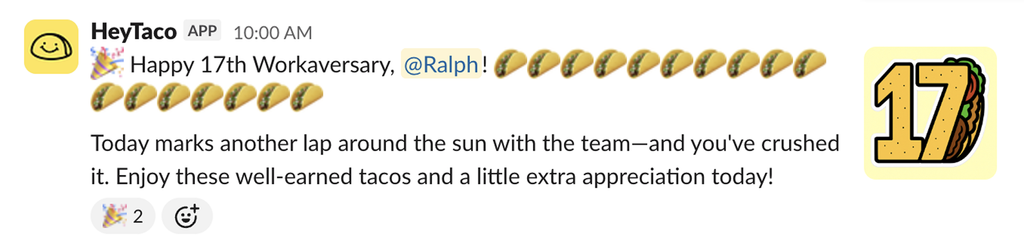
We also left that session and turned on automated work anniversary and birthday recognition, which we had been tracking with other tools (like spreadsheets and calendar reminders) for years.
A distributed team that thanks each other daily is a team that flags a problem early
Recognition is low-stakes practice at saying something directly to a colleague. A team in that habit is more likely to raise a risk on a project in week two than in week nine, which is most of what transparent partnership means in practice.
Thank you to Una Japundza and the HeyTaco team for the time and the candor. It says something about a partner that, given forty-five minutes with a client, they spend it on habits rather than features.
If you are weighing a digital partner, let’s talk. If you came for the culture, you can read more about how we work and who we are, and we list open roles as they come up.