When organizations invest in a new website, the conversation usually starts in the right place. There’s a goal in mind: grow awareness, improve conversions, support the sales team, serve members better. The intent is clear. The investment is real.
Then the project starts. Requests come in from marketing, IT, leadership, and every department that has ever had a complaint about the current site. Without something to govern against, a clear hierarchy of what the project is actually trying to accomplish, priorities shift, scope expands, and the original goal gets buried. Research consistently shows that the majority of digital projects fail not because of execution problems, but because of misalignment at the goal level.
The problem is rarely the website itself. More often, it’s that the goals were set at the wrong level, or were never clearly connected to each other, from the start.

Goals are not one-size-fits-all
A goal for your website is not the same as a goal for your business. And a goal for your business is not the same as a goal for a specific digital campaign. Treating these as interchangeable leads to websites designed around assumptions rather than needs.
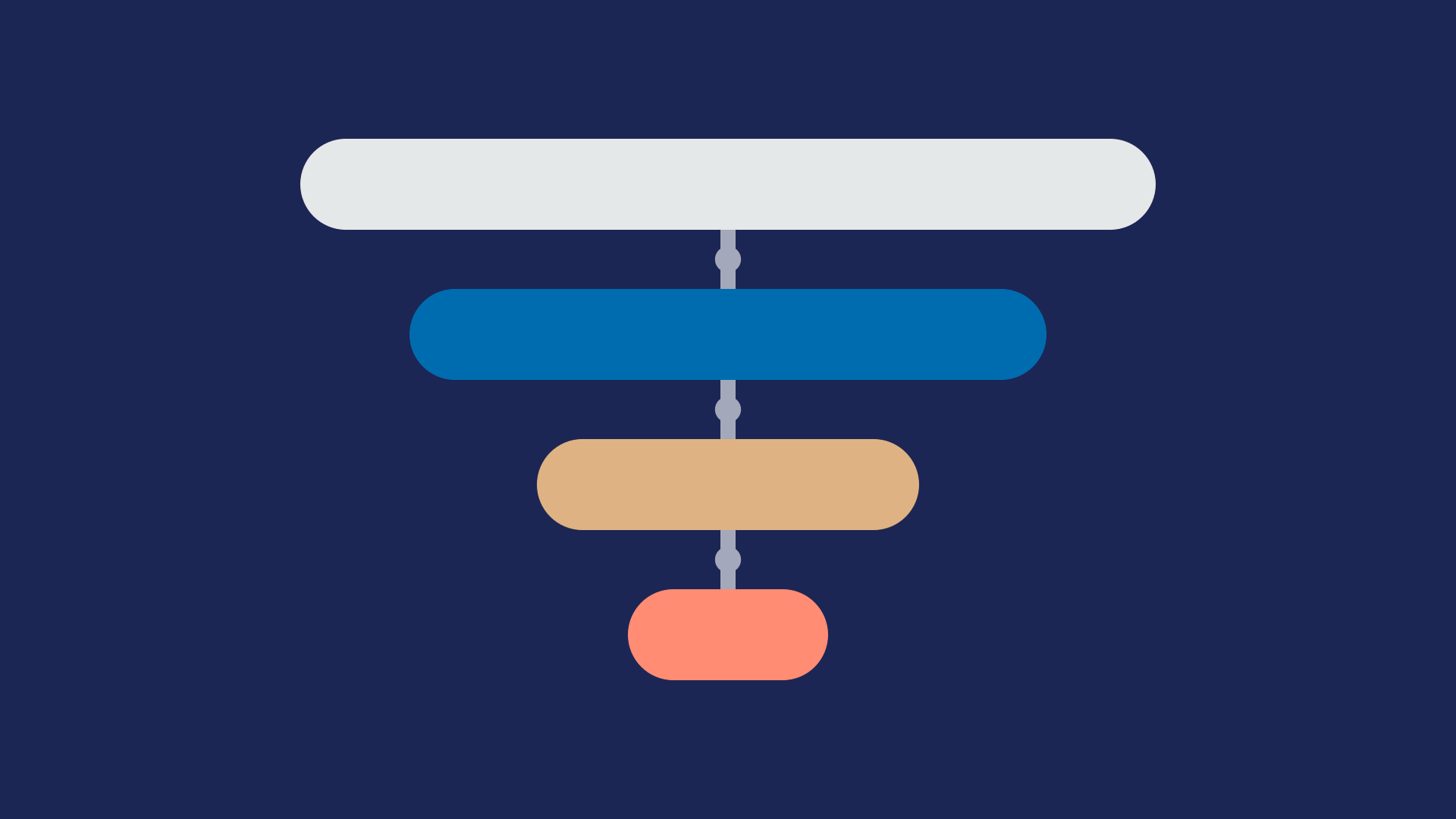
At COLAB, we think about goals in four distinct layers, each feeding the one below it. This is the framework we use at the start of every project to make sure that what we build is built for the right reasons.
Marketing Goals
These describe your business outcomes. They live at the highest level of your strategy and are owned, and accountable, outside the website. Think: increase new member enrollment by 15% this fiscal year. Expand patient acquisition in a new service line. Grow individual giving by 20%.
Marketing goals don’t describe what the website does. They describe what the organization is trying to achieve. The website’s job is to support those goals, not to own them.
This distinction matters because it changes how you evaluate the website’s performance. If the goal is membership growth and membership is flat, the question isn’t just “is the website working?” It’s “what role is the website playing in a larger ecosystem, and is that role clearly defined?”
Digital Goals
Digital goals describe behavior and performance across your digital channels: your website, email, paid campaigns, and social presence taken together. They translate business intent into measurable digital outcomes.
If the marketing goal is to grow new member enrollment, a digital goal might be: increase qualified traffic from organic search by 30%, or improve lead-to-membership conversion rate across digital touchpoints by 10%.
These goals live at the channel level. They require coordination across your team, and they provide the criteria against which all digital investments, including the website, are measured.
Website Goals
Website goals describe what the website itself must do to support your digital goals. This is where specificity starts to matter most.
If the digital goal is to improve conversion rate, a website goal might be: reduce friction in the membership application flow, or improve clarity on the benefits page to increase time-on-page and click-through to the application.
Notice the shift. Rather than outcomes, we’re talking about behavior. What should a visitor do? Where should they go? What should they understand, and how quickly? Website goals are about designing an experience that does its job. They are testable, observable, and directly tied to the digital and business goals above them.
Project Goals
Project goals describe what “done” looks like for a specific effort: a redesign, a campaign landing page, a new feature, a technical migration.
They are the most concrete of the four layers. A project goal might be: launch a redesigned benefits page with updated copy, improved navigation, and a simplified application CTA by August. Or: migrate the legacy patient portal to the new platform with no loss of user accounts and full QA sign-off.
Project goals are scoped, time-bound, and verifiable. They create shared expectations between marketing, IT, agency partners, and leadership about what is actually being built and how success will be measured when the work is done.

Why the hierarchy matters
Each layer depends on the one above it. Project goals exist to achieve website goals. Website goals exist to support digital goals. Digital goals exist to deliver on marketing goals. When this chain is clear, every decision in a website project, design, content, architecture, measurement, has a rationale.
When it isn’t clear, projects drift. Scope expands. Disagreements surface late. And the website that launches may look like what was asked for, but not deliver what was needed.
This is not a failure of execution. It’s a failure of alignment at the goal level, and it tends to happen quietly, before the project even starts.
What this means for your next project
Getting this right doesn’t require a lengthy strategy engagement. It requires a deliberate conversation early in the process: one that starts with business outcomes and works down to the specific work to be done.
If your team can articulate the marketing goal, the digital goal, the website goal, and the project goal, and trace the connection between them, you’re in a strong position to build something that actually performs. If those layers are fuzzy or disconnected, that’s worth knowing before the first wireframe is drawn.
This is how we start every project at COLAB. If you’re preparing for a website effort and want to think through your goals before the work begins, we’d be glad to have that conversation.