According to the 2025 M+R Benchmarks study, more than 87% of visitors who land on a nonprofit donation page leave without completing a gift. Not indifference. Not lack of awareness. Just friction: pages that load too slowly, forms that ask too much, unclear statements of purpose that fail to make the case for urgent support. The money didn’t pause. It disappeared.
Your marketing campaigns generate traffic. Your email open rates meet industry benchmarks. People land on your website ready to learn about your cause. Then, they leave without making a donation.
If you serve in the nonprofit sector, you face unique barriers that aren’t always visible to your board. We’ve seen the pattern across dozens of organizations: resource constraints, competing priorities, and platforms that don’t fit the way your team actually works. Learn more about our nonprofit work.
A website without a clear path to action is a drain on your marketing budget. For mission-driven organizations, a poorly structured site does more than underperform. It fails the people it was built to serve. When online giving stays flat despite increased marketing spend, the instinct is often to push more traffic.
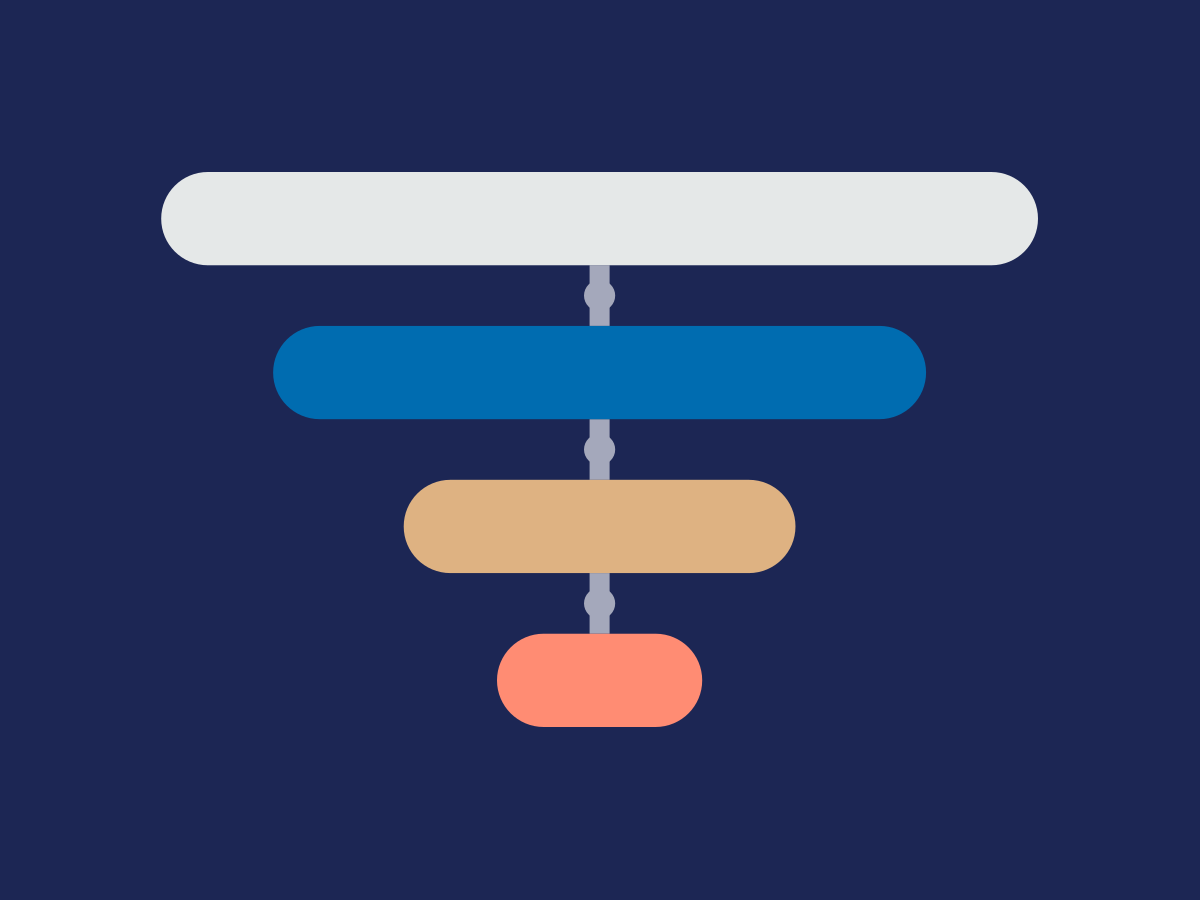
That approach wastes money. Traffic cannot fix a broken conversion funnel.
If your donor acquisition costs are rising while campaign return on investment drops, the problem is rarely your audience. The problem is your website infrastructure. Silent conversion killers actively push high-intent visitors away. Identifying these barriers is the first step to improving your digital presence and increasing revenue.
Here are the specific points of friction costing your organization donations, and what to do about them.
On Strategy
Traffic cannot fix a broken conversion funnel.
→ The fix is structural, not more spend
The Cost of a Slow Website
Patience is not a resource you can rely on. According to Google research, 53% of mobile users will leave a page that takes more than three seconds to load.
Heavy images, bloated code, and excessive tracking scripts drag down performance. You spend thousands of dollars driving a prospective donor to a landing page. A slow load time throws that investment away in milliseconds. The donor assumes the site is broken. They close the tab. You lose the donation.
This technical failure directly impacts your marketing analytics. High bounce rates signal to search engines that your site lacks value. This lowers your organic search ranking. You are forced to spend more on paid acquisition to make up the difference. A slow site artificially inflates your donor acquisition cost.
Fixing load times requires a technical audit, not a guess. You need to identify what slows the browser down. Strip out unnecessary plugins. Compress media files. Serve assets through a content delivery network.
Speed is a fundamental requirement for trust. A fast site tells the visitor your organization is capable and professional. It gets out of their way.
Hiding the Mission Above the Fold
Clarity drives action. Vagueness creates confusion.
Many nonprofit websites open with a beautiful hero image and a vague slogan. The visitor lands on the homepage and cannot figure out what the organization actually does. They have to scroll, read dense paragraphs, and search for context.
Most will not do the work. They will leave.
The space visible on a screen before a user scrolls is your most valuable real estate. If you do not state your mission plainly in that space, you lose the audience. High-intent donors need immediate validation that they are in the right place. They need to know what problem you solve and how their money helps.
Replace abstract slogans with direct statements. State the problem. State your solution. Tell the visitor exactly what their support achieves. Clarity always outperforms cleverness.

Treating Donations Like Tax Paperwork
The user clicks the “Donate” button. They have decided to give. Then they see the form.
It spans two pages. It asks for their middle initial, their phone number, and their home address. It requires them to create an account with a password. It looks like a tax document.
Friction at the point of transaction kills conversions. When a donation form is built to satisfy internal database requirements rather than user experience, form abandonment rates climb. Every additional field you add to a form reduces the likelihood of completion.
A form should ask only for the information necessary to process the payment: name, email, and credit card details. Yes, even if your data team wants more. You can always ask for additional details after the payment clears. The post-donation confirmation page is the correct place to request mailing addresses or phone numbers.
Streamline the flow. Reduce the steps. Make the act of giving the easiest thing to do on your website.
By the Numbers
87%
of visitors who land on a nonprofit donation page leave without completing a gift
→ 2025 M+R Benchmarks
Leave
Give
Disconnected Tools and Broken Trust
Marketing leaders rely on data to make decisions. When your website, your email platform, and your payment processor do not communicate with each other, you lose visibility. You cannot trace a donation back to the specific campaign that generated it. You cannot measure return on investment accurately.
This disconnection also impacts the donor. If the payment process redirects them to a third-party site that looks entirely different from your brand, they lose trust. They abandon the transaction. Your digital infrastructure must maintain visual consistency and reliable security protocols from the first click to the final receipt.
Integration is necessary for modern marketing teams. Your systems must share data cleanly. When tools communicate properly, your team spends less time manually moving data and more time analyzing results.
What This Looks Like in Practice
Better Housing Coalition came to COLAB with an outdated website that made it difficult for home seekers to find essential information and for donors to engage effectively. We redesigned the site with a clear user interface, distinct navigation paths for each audience, and direct pathways to donate. The result: a 300% increase in traffic to their Donate pages, and revenue growth of 139% over eight years, from $3.11 million to $7.44 million.
The Richmond Symphony faced a similar challenge. Their website contained substantial information with no clear way to navigate it. Visitors struggled to find programs, and the site failed to communicate the experience of attending a performance. After a redesign focused on clarity, structure, and UX design, the Symphony saw a 61% increase in pageviews and a 24% decrease in bounce rate within two months of launch.
These outcomes are not exceptional. They reflect what happens when the structural problems are addressed directly.

How COLAB Fixes the Foundation
At COLAB, we partner with organizations where digital decisions carry real responsibility. We look at the reality of your current systems before recommending a change. We identify the specific points of friction hurting your conversion rates. If a CRM integration is causing form abandonment, we fix the integration. If bloated code is killing your load times, we clean the architecture.
We tell you what you need to hear. If a feature will cause problems later, we say so. Transparency is not optional when trust matters.
We define the right strategy, making it clear who you serve and how you serve them. Strong content means donors understand your impact in a few words, not a few clicks. Reliable design ensures calls to action are visible where they matter most. Solid development removes invisible technical roadblocks that kill load times or break integrations.
We build systems your team can actually manage. We prioritize clean code, clear documentation, and durable architecture. Launch is not the finish line. We work alongside you as your organization grows.
Next Steps for Marketing Leaders
Start by testing your own website. Open a private browser window. Navigate to your homepage. Time how long it takes to load. Read the first headline you see. Ask yourself if a stranger would understand your mission in five seconds.
Then try to make a five-dollar donation. Count the number of fields. Note any moments of frustration or delay. What annoys you will repel a donor.
Review your analytics to see where traffic drops off. Look at bounce rates on your primary landing pages. Check abandonment rates on your donation forms. Data will show you where the system is failing. Fixing those failures will improve your return on investment faster than any new marketing campaign.
Stop letting bad infrastructure drain your budget. Schedule a conversation with COLAB. We’ll give you plain answers on where your site loses revenue, and what it takes to start turning visitors into donors.

We work with nonprofits on the digital problems that affect how you reach donors, volunteers, and the communities you serve.