If you lead marketing at a nonprofit, you’ve probably had a version of this conversation more than once. The development team has a campaign coming up. The board wants to see something digital. Someone needs to figure out what gets built, by whom, and by when.
In our work with nonprofit clients, the request almost always falls into one of three buckets:
- A microsite for an upcoming capital campaign
- A landing page for a one-off campaign or year-end push
- Help writing a grant proposal, often with a question about how AI fits in
These three asks are the most common conversations we have with nonprofit teams. They share something most teams don’t see at first.
Each one gets meaningfully stronger when the organization’s main website is treated as part of the fundraising infrastructure, not as a separate property that lives in marketing’s lane.
Your nonprofit website is doing more fundraising work than most teams realize. It’s where prospective donors go before they decide to give. It’s where funders go before they decide to fund. It’s where program staff send people who want to learn more, and where board members forward links to their networks. The site is already part of every fundraising conversation. The only question is whether it’s helping or quietly working against you.
Below, we walk through each of the three tactics and look at the specific ways a well-built website supports the work.
The website as foundation
A nonprofit website is doing four jobs at once for fundraising:
- Establishing credibility with people who don’t know your organization yet.
- Providing evidence and proof points that a donor or funder will reference when deciding whether to give.
- Housing the giving infrastructure that turns donor intent into a completed gift.
- Serving as connective tissue between every campaign, proposal, and outreach effort your team runs.
When the site is doing those four jobs well, every fundraising tactic gets easier. When the site is fragmented, slow, hard to update, or inconsistent with how the organization presents itself in person, every tactic has to work harder to compensate.
1. Capital campaign microsites
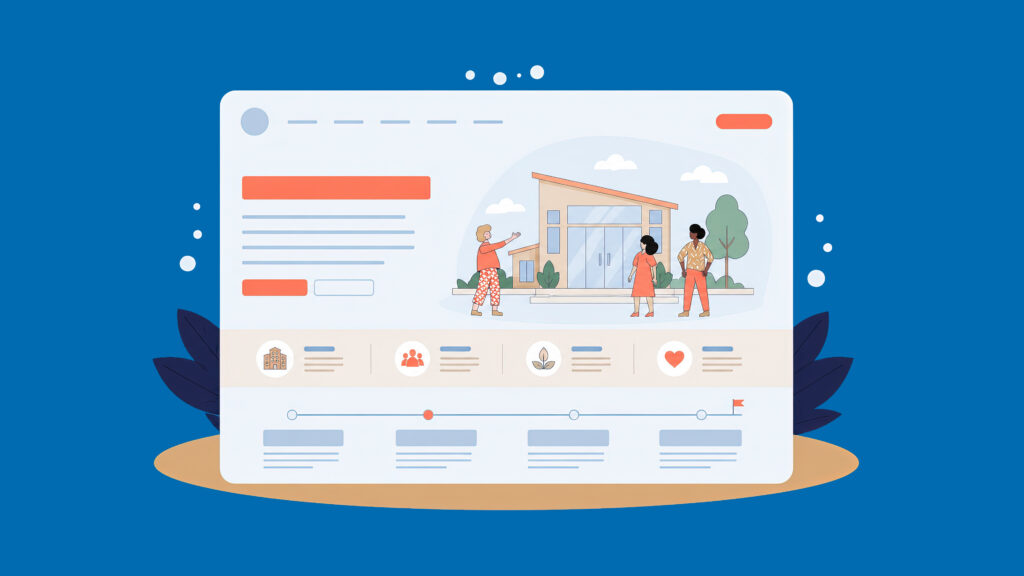
A capital campaign deserves its own dedicated home on the web. It carries a distinct story, a distinct audience behavior, and a multi-year timeline that doesn’t fit cleanly inside your day-to-day site navigation. A capital campaign microsite gives the campaign room to breathe.
Industry context
Most capital campaigns run three to five years from early planning through completion, according to fundraising standards published by the Association of Fundraising Professionals and the Giving Institute.
What people miss is how much the main website determines whether the microsite succeeds.
A donor visiting your campaign microsite is rarely seeing it cold. They’ve usually been to your main site first, or they go to the main site to verify that the organization behind the campaign is the one they think it is. If the main site is dated, slow, or doesn’t reflect the organization’s current voice, the microsite has to work against that impression. If the main site reinforces the case, the microsite gets to do its real job: making the specific argument for the campaign.
How the main website supports a capital campaign microsite:
- The main site carries the long-form proof. Annual reports, financials, program outcomes, leadership bios, board lists, and accreditations all live there. A microsite can reference them without rebuilding them, and donors who want to do their own due diligence have somewhere credible to go.
- The main site handles ongoing audience navigation. Donors who hear about the organization through the campaign and want to understand the broader work end up on the main site. If that site is well-organized and clearly written, the campaign expands the organization’s audience instead of just hitting a single goal.
- The giving infrastructure is shared. The same payment processor, CRM integration, and gift acknowledgment workflows that handle day-to-day giving on the main site can be configured to support the microsite. That’s faster to set up, easier to maintain, and more reliable than standing up parallel systems.
- The content model can be shared. If your main site is built so your team can update it, the microsite can usually be built the same way. That matters over a multi-year campaign, when the people who launch the site may not be the people maintaining it eighteen months in.
A microsite is not the campaign. But a well-built site makes the campaign easier to run and easier to win.
2. One-off campaign landing pages
Year-end giving. Matching gift challenges. Emergency response. Advocacy moments. A focused nonprofit landing page is the right tool for each of these. The window is short, the ask is specific, and the audience is making a fast decision.
Industry context
Nonprofits raised 37 percent of all online revenue in December alone, with the last week of the year accounting for roughly 10 percent of total annual online revenue, according to the M+R Benchmarks 2025 report. Year-end concentration varies widely by sector, ranging from 23 percent in cultural organizations to 52 percent in rights-focused nonprofits.
A good landing page is disciplined. One ask. One audience. One decision the visitor should be able to make. Everything on the page should help them make it.
What’s less obvious is how much the main website determines whether the landing page actually performs.
How the main website supports a campaign landing page:
- Traffic patterns. Most nonprofit landing pages get a meaningful share of their traffic from people who first visited the main site. Email subscribers, social followers, and donors from previous years often start at the homepage and follow a campaign banner to the landing page. If the main site can surface the campaign cleanly and route people to the landing page in one or two clicks, the campaign captures traffic it would otherwise lose.
- Brand consistency. A donor who sees a polished campaign landing page and then clicks through to a main site that looks and feels different will quietly lose trust, even if they can’t articulate why. When the main site and the landing page share a design system, the experience holds together.
- Retargeting and follow-up. Visitors who came from the site and didn’t give can be reached again through email or paid retargeting, but only if the website is set up for it. Tag management, consent flows, and email platform integration all live on the main site, and they determine how much you can do with the audience your campaign attracts.
- Post-gift pathways. The strongest campaigns don’t end at the gift. The thank-you page, the receipt email, and the follow-up communications all benefit from being able to point donors back to relevant content on the main site. New donors who feel welcomed into the organization’s broader work renew at higher rates than those who feel like they completed a transaction and left.
Industry context
Mobile users accounted for 53 percent of visits to nonprofit websites in 2024, while desktop visitors generated 72 percent of online revenue with an average gift of $168 versus $88 on mobile, according to the M+R Benchmarks 2025 study.
Teams often treat one-off landing pages as standalone projects. The deadline is real and the scope feels contained. But the landing pages that perform best are the ones built on top of a website that’s already doing its job well.

3. Grant writing and what AI is changing
The third common ask is grant writing, and increasingly the question is how AI tools fit into the work.
Industry context
82 percent of nonprofits now use AI in some form, though fewer than 10 percent have formal policies governing its use, according to TechSoup’s 2025 AI Benchmark Report. The most common uses are checking grammar, brainstorming headlines, and creating first drafts of content.
The website is more relevant to grant writing than most teams realize.
Funders read websites. Program officers, foundation staff, and grant reviewers visit your main site as part of their evaluation. They check whether the organization’s public presentation matches what’s in the proposal. They look at program pages, impact data, leadership, board, and recent activity. A site that’s organized, current, and substantive supports the proposal. A site that’s stale, vague, or contradicts the proposal language quietly undermines it.
That alone is reason enough to think of the website as part of grant strategy. But there’s a second reason, and it’s where AI comes in.
The grant writers we see getting real value from generative AI are using it as a writing partner that draws from organizational source material. The quality of what AI produces depends almost entirely on what it has to work with.
The website is where your case for support already lives. AI can only work with what you’ve written down.
How the main website supports better grant writing:
- Program pages function as source material. When the website describes each program clearly, with current data, named outcomes, and the language your team uses, those pages become inputs that AI tools and human writers can both draw from. The website is doing the work of organizing your case, which means every proposal starts further along.
- Impact and evidence are centralized. If annual outcomes, evaluation findings, and key statistics live in a consistent place on the site, they’re easy to reference, easy to update, and easy to cite. A common failure mode in grant writing is repeatedly hunting for the right number across old documents.
- Voice samples are accessible. Whether you’re prompting an AI tool or briefing a new staff writer, having clear examples of how the organization sounds matters. The website is the largest single body of voice samples your organization has.
- The site itself is part of the case. Funders rarely fund organizations that don’t look like they can deliver. A website that demonstrates organizational maturity, communicates with care, and presents the work clearly is part of how your team makes the case for capacity, often before a proposal is reviewed.
AI is changing what the workflow looks like. It is not changing what makes a proposal strong. The organizations getting the most out of AI in grant writing are the ones with the strongest source material, and for most nonprofits, the website is where that source material lives.
What this means for how you invest
The three formats above are different fundraising tactics. They serve different moments and require different decisions. But they all benefit from the same underlying investment: a nonprofit website doing its job as fundraising infrastructure.
That doesn’t mean every fundraising project starts with a full site rebuild. It means treating the main website as part of the fundraising work, not separate from it.
When we partner with nonprofit teams on capital campaigns, year-end pages, or grant strategy, the website foundation is part of the conversation from the start. Sometimes the work is on the main site. Sometimes it’s on a campaign-specific property. Often it’s both, in a sequence that fits your timeline and budget.
Let’s talk about your campaign
If you have a capital campaign, a year-end push, or a major grant cycle on your calendar this year, we’d love to hear what you’re working on. Start a conversation with us about the campaign and the digital pieces it will need. We’ll bring questions, not a pitch.

We work with nonprofits on the digital problems that affect how you reach donors, volunteers, and the communities you serve.